

Module 19
Training Systems, Competency Development and Emerging Trends
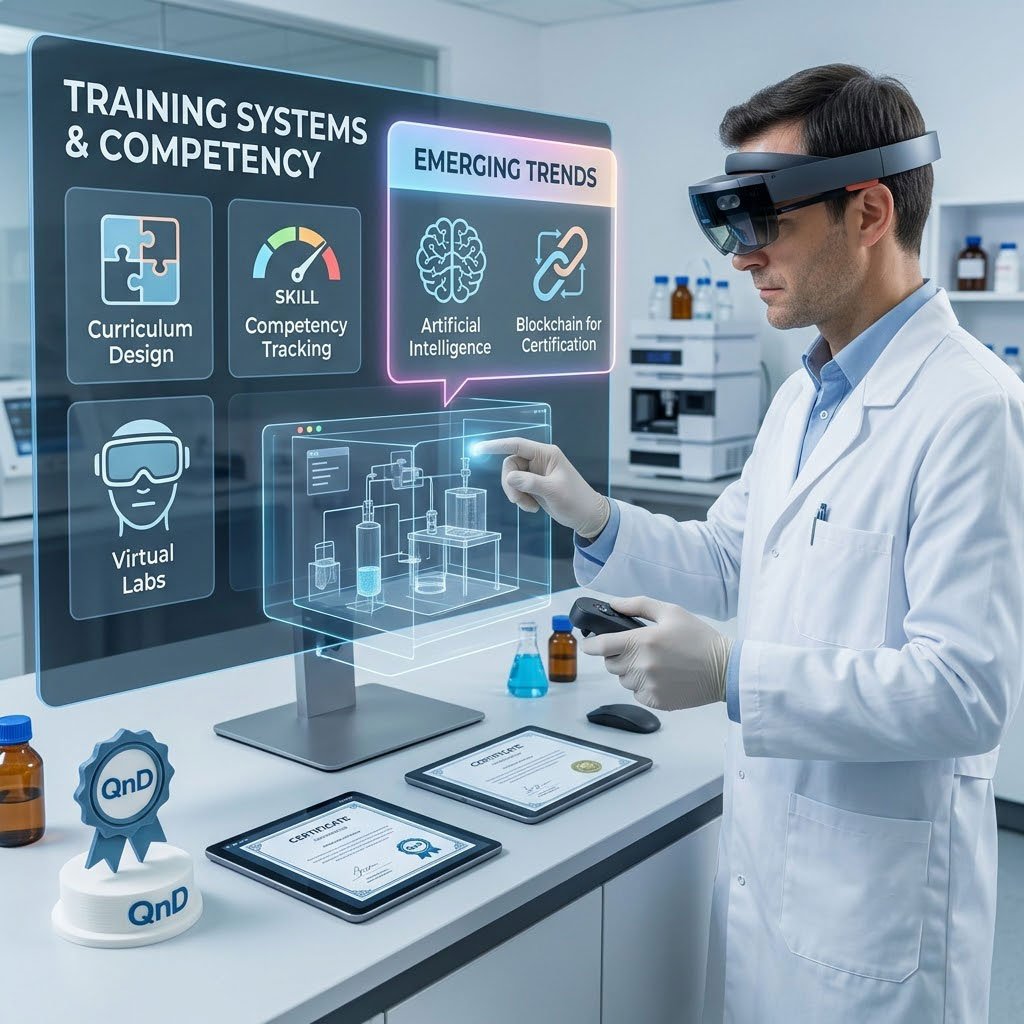
Course Overview
This course establishes the essential understanding needed to design, implement, govern and evaluate pharmaceutical training systems that produce genuine competency rather than documented completion, and to engage with the emerging technologies and regulatory developments that are reshaping pharmaceutical manufacturing, quality management and compliance at a pace the industry has not previously experienced.
Training is simultaneously one of the most universal GMP requirements and one of the most persistently inadequate elements of pharmaceutical quality systems. Every regulatory framework from EU GMP to FDA 21 CFR to ICH Q10 requires that personnel be trained. What they uniformly and explicitly do not accept is training records as a substitute for demonstrated competency. A signed training record, a completed e-learning module or a certificate of attendance confirms that a training event occurred. It does not confirm that the learner can perform the relevant task correctly, make appropriate judgements under real conditions, recognise when something is wrong, or escalate concerns at the right moment. Regulators have made this distinction clear through inspection findings, guidance documents and Warning Letter observations over many years. Organisations that have not responded to it continue to carry inspection risk from a source that is entirely within their control.
The pharmaceutical training landscape is also changing in ways that both create new capabilities and introduce new compliance obligations. Digital learning platforms, e-learning content, virtual reality simulation, AI-driven adaptive learning, remote assessment tools and learning management systems with extended analytical capability are transforming how training is designed, delivered, measured and governed. These technologies offer genuine improvements in training reach, consistency, engagement and effectiveness measurement, when they are implemented with appropriate quality oversight, validated where required, and assessed against the same competency evidence standard that applies to any other training method. When they are adopted primarily for cost reduction or compliance appearance, they tend to reproduce the same inadequacies in a more technically sophisticated format.
The second major dimension of this course looks beyond training to the broader emerging trends reshaping pharmaceutical compliance and manufacturing: artificial intelligence and machine learning applications in quality management, manufacturing control and regulatory review; digital transformation and Industry 4.0 in pharmaceutical operations; continuous manufacturing and its regulatory implications; advanced therapy medicinal products and the compliance infrastructure they require; and how regulatory agencies globally are beginning to adapt their frameworks to an industry increasingly characterised by connected systems, real-time data and automated decision-making. Professionals who understand these trends (not as marketing concepts but as operational realities with specific regulatory, technical and governance implications) are better positioned to navigate the changes already underway and those approaching.
This course is the final module in the Pharmy Academy programme and is designed to close the subscription learning journey by connecting the operational quality foundations built across Modules 1 to 17 to the future of the industry those foundations serve.
Learning Outcomes
By the end of this course, learners will be able to:
- Explain the regulatory basis for pharmaceutical training under EU GMP, FDA 21 CFR and ICH Q10, and distinguish between training completion, training effectiveness and demonstrated competency as distinct and regulatory-significant concepts.
- Conduct a training needs analysis that identifies genuine skill and knowledge gaps linked to role-specific quality and compliance requirements, and prioritise training interventions proportionate to the patient safety, product quality and regulatory risk of the identified gaps.
- Design pharmaceutical training programmes with clear learning objectives, appropriately structured content, suitable delivery methods, integrated assessment and measurable competency
- Explain the qualification requirements for trainers in a regulated pharmaceutical environment and describe how trainer competency should be assessed, documented and maintained.
- Apply digital and blended learning approaches in pharmaceutical training with appropriate quality oversight, including the validation considerations for e-learning platforms and learning management systems as regulated electronic systems.
- Design competency verification, performance observation and assessment programmes that provide genuine evidence of training effectiveness rather than confirming that training occurred.
- Apply trending and periodic review to training programme data (including assessment performance, competency verification outcomes, deviation rates linked to training gaps, audit findings and refresher training triggers) as an active quality management tool.
- Explain how AI and machine learning are currently being applied in pharmaceutical quality management, manufacturing control, regulatory submissions and drug development, and describe the current regulatory agency thinking on AI in GxP-regulated environments.
- Describe the compliance implications of digital transformation and Industry 4.0 in pharmaceutical manufacturing, including connected equipment, real-time data management, predictive analytics, automated decision support and the data integrity governance that these capabilities require.
- Explain the current regulatory framework for continuous manufacturing, including ICH Q13, EMA and FDA guidance on continuous manufacturing submissions and the quality system adaptations required for continuous processes.
- Describe the quality and compliance infrastructure required for ATMP manufacturing, including the specific regulatory framework under EU ATMP regulation, the role of the ATMP QP, and the particular challenges of contamination control, comparability, characterisation and release testing in ATMP operations.
- Explain how regulatory agencies are adapting their inspection approaches, guidance frameworks and approval processes to address the emerging technological and scientific landscape, and what that adaptation means for pharmaceutical organisations operating within it.
- Recognise how different departments (including HR, training functions, QA, production, QC, IT, engineering, regulatory affairs and senior leadership) affect training system effectiveness, competency culture and the organisation’s readiness for technological change.
- Identify situations requiring escalation, including training systems that cannot demonstrate competency evidence, persistent performance gaps not addressed by current training, digital system implementations with unresolved data integrity governance, and emerging technology deployments without adequate regulatory impact assessment.
Course Content
Training-related inspection findings are among the most consistent and most avoidable sources of regulatory observations in pharmaceutical operations. The finding is rarely that training did not happen. It is almost always that the training that happened did not demonstrate competency, that the training system cannot show it worked, or that the connection between training and the quality system (through deviation investigation, CAPA, competency assessment and performance monitoring) does not exist in practice.
The consequences of training system inadequacy are not limited to inspection findings. An operator who has completed a training record on line clearance but has not demonstrated competency in performing one is an operator who may perform a line clearance incorrectly. A laboratory analyst whose training in OOS investigation procedures is evidenced by a signed document rather than observed performance is an analyst who may invalidate a result for inadequate reasons without anyone recognising the error until an inspector asks why. A QA professional trained in deviation investigation by reading an SOP rather than practising the process is a QA professional who may write deviation reports that satisfy the form requirements without identifying root cause. Training that does not change behaviour does not protect patients, and regulators increasingly require organisations to demonstrate that it does.
The emerging technology dimension is essential for a different reason. The pharmaceutical industry is in the early stages of a technological transformation that will change how products are developed, how manufacturing processes are controlled, how quality data are analysed, how regulatory submissions are reviewed and how inspections are conducted. Artificial intelligence is already being applied to regulatory submission review at FDA and EMA. Machine learning is being applied to process analytical technology data, batch release decisions, adverse event detection and supply chain risk management. Continuous manufacturing is moving from innovator-led development into wider commercial adoption. ATMPs are growing from rare exceptions into an established and expanding category of medicinal product. Digital twins, real-time process monitoring, predictive maintenance and automated quality decision support are moving from pilot programmes into operational deployment.
Professionals who engage with these developments from a position of informed understanding (knowing what the regulatory frameworks say, what the data integrity obligations are, what the validation and assurance requirements look like, and what the risks are as well as the opportunities) are the professionals who will help their organisations navigate this transition well. Those who wait for the transformation to stabilise before engaging with it will find that the regulatory and operational landscape has moved on without them.
The Regulatory Basis for Pharmaceutical Training and the Competency Standard
The course opens by establishing the regulatory requirement for pharmaceutical training across EU GMP, FDA 21 CFR and ICH Q10, not as a list of what each framework says, but as an explanation of what each framework means when it requires training and competency evidence. Learners will understand why regulators distinguish between training attendance, training completion, training effectiveness and demonstrated competency, and why the last of these is the standard that inspection evidence must meet.
The course examines how training-related inspection findings typically arise: training records that are complete but competency verification that is absent, SOP training completed by reading without observation of performance, refresher training triggered by time elapsed rather than by performance data, training system governance that tracks completion without tracking outcomes, and training records stored in an LMS without any mechanism for connecting training performance to quality performance.
Training Needs Analysis
Training needs analysis is addressed as the foundational step of a competency-based training programme. Learners will understand how to identify genuine skill and knowledge gaps, not simply by listing role responsibilities and matching them to available training content, but by assessing what competencies a role genuinely requires, what the current competency level of the person in the role is, and what the risk to quality and compliance is if that gap persists.
The course covers different TNA approaches: job and task analysis, competency framework development, performance data review, deviation and quality event analysis as a source of training gap signal, audit finding analysis, regulatory expectation review and periodic curriculum review.
Training Programme Design: Objectives, Content, Delivery and Assessment
Training programme design is addressed with practical detail covering the complete design sequence. Learners will understand how to write learning objectives that describe observable, assessable behaviours (not what the learner will be exposed to, but what the learner will be able to do after training) and how learning objectives drive content selection, delivery method choice and assessment design.
Delivery method selection is covered in practical terms (classroom training, on-the-job training, e-learning, blended learning, mentored practice, peer assessment, simulation, virtual reality and structured observation) with guidance on when each method is appropriate for different learning objectives and different learner profiles.
Assessment design is addressed as the element of training programme design most commonly inadequate. Learners will understand how to design assessments that test application of knowledge and decision-making rather than recall of information, how to use competency observation frameworks to assess practical skill, and how to set and apply passing standards that reflect the competency level required for the role.
Trainer Qualification in a Regulated Environment
The qualification requirements for trainers delivering GMP-relevant training are addressed in practical terms. Learners will understand what regulators expect when they ask about trainer qualification: not merely that the trainer is knowledgeable about the subject, but that they have been assessed as capable of delivering training effectively, that their qualification is documented, and that it is periodically reviewed.
Digital and Blended Learning in Pharmaceutical Training
Digital and blended learning approaches are addressed with appropriate quality oversight context. Learners will understand what digital learning tools are available (LMS platforms, SCORM-compliant e-learning, video-based learning, virtual classroom tools, mobile learning, AI-driven adaptive learning platforms) and how to evaluate and implement them with the regulatory and data integrity considerations that apply to electronic systems used in GMP-regulated activities.
Learning management system validation is addressed as a specific application of computerised system assurance principles. Learners will understand how an LMS functions as a GMP-relevant system and what validation, access control, audit trail and data integrity requirements apply as a result.
Measuring Training Effectiveness: Competency Verification and Performance Trending
Training effectiveness measurement is addressed as the most critical and most frequently underdeveloped element of pharmaceutical training systems. Learners will understand how to design competency verification programmes and how performance trending as a training quality tool can signal training gaps, identify functions or topics where competency development is insufficient, and trigger targeted training intervention before the quality impact accumulates into an inspection finding.
AI and Machine Learning in Pharmaceutical Quality and Manufacturing
The emerging trends section opens with artificial intelligence and machine learning as they are currently being applied in pharmaceutical operations, not as future possibilities but as current realities at different stages of adoption across the industry. Learners will understand the specific applications where AI is being deployed: predictive quality analytics using batch manufacturing data, machine learning-based process analytical technology for real-time attribute prediction, AI-assisted regulatory submission review at FDA and EMA, natural language processing for adverse event signal detection, computer vision for visual inspection and packaging quality control, and predictive maintenance in manufacturing equipment management.
The regulatory framework for AI and machine learning in GxP-regulated environments is addressed with the depth that current guidance supports and the honesty that the state of that guidance requires. Three specific documents frame the current regulatory position. FDA’s January 2021 action plan for AI/ML-based software as a medical device set out the agency’s thinking on lifecycle management, algorithm change protocols and transparency for AI/ML-based SaMD; it is primarily scoped to medical device software, but signals wider FDA intent on algorithm governance. FDA’s January 2023 discussion paper “Artificial Intelligence in Drug Manufacturing” explicitly addressed AI/ML applications in pharmaceutical manufacturing contexts (including process monitoring, quality control and batch release support) and described FDA’s current thinking on how existing CGMP frameworks apply to AI-enabled manufacturing. EMA’s March 2023 reflection paper on the use of artificial intelligence in the lifecycle of medicinal products covers AI applications across development, manufacturing and pharmacovigilance and sets out EMA’s initial framework positions, with more detailed guidance development ongoing. The course makes clear what these documents address, where they leave questions open, and what organisations deploying AI in GMP-regulated activities need to consider in the absence of fully settled regulatory guidance.
The data integrity implications of AI in pharmaceutical manufacturing are addressed specifically: how AI systems generate, process and use data; what audit trail, traceability and explainability requirements apply; how algorithmic decision-making in GMP contexts interacts with the human accountability that GMP frameworks require; and how organisations should govern AI deployments that affect product quality, patient safety and regulatory compliance.
Digital Transformation and Industry 4.0 in Pharmaceutical Operations
Digital transformation and Industry 4.0 are addressed as operational realities rather than strategic concepts. Learners will understand what connected manufacturing, real-time data management, digital twins, automated process control, electronic batch records, paperless manufacturing and smart packaging mean in practice for pharmaceutical operations, what capabilities they provide, what compliance obligations they create, and what the data governance and validation requirements are for the systems that enable them.
Continuous Manufacturing: ICH Q13 and Regulatory Implications
Continuous manufacturing is addressed as an established and growing manufacturing approach with specific regulatory implications. Learners will understand how continuous manufacturing differs from batch manufacturing in terms of process design, process control, material traceability, batch definition, real-time release testing and regulatory submission requirements. The ICH Q13 guideline on continuous manufacturing of drug substances and drug products is addressed in practical terms, what it requires in a regulatory submission, how it interacts with ICH Q8, Q9, Q10 and Q14, and what the inspection expectations are for commercial continuous manufacturing operations.
Advanced Therapy Medicinal Products: Compliance Infrastructure and Regulatory Framework
ATMPs (gene therapies, cell therapies, tissue-engineered products and combined ATMPs) are addressed as a category of medicinal product with a specific and demanding regulatory and compliance infrastructure. Learners will understand the EU ATMP regulation framework, the role of the Committee for Advanced Therapies at EMA, the ATMP QP obligation and how it differs from the standard QP role, and the specific GMP requirements for ATMP manufacture.
Regulatory Agency Adaptation to the Evolving Pharmaceutical Landscape
The final section addresses how regulatory agencies are adapting their frameworks, inspection approaches and approval processes to the technological and scientific changes underway in the industry. The course concludes by connecting the emerging technology and regulatory trends back to the foundational quality principles that have run throughout the programme: patient protection, licence accountability, escalation behaviour, cross-functional responsibility and the Pharmaceutical Quality System as the organisational framework within which all of these developments must operate. Technology changes. The obligation to protect patients and operate with integrity does not.
- Training Managers, Learning and Development professionals and Organisational Development specialists in pharmaceutical, CDMO, CMO and MAH organisations.
- QA professionals responsible for training system oversight, training record governance, competency verification programme design and inspection readiness for training systems.
- HR professionals with pharmaceutical GMP training responsibilities, curriculum management or LMS governance roles.
- Site Quality Directors and VP Quality roles whose management review responsibilities include training system performance and whose inspection preparation includes training system defence.
- Digital transformation leads, innovation managers and technology programme managers in pharmaceutical and CDMO organisations navigating Industry 4.0 implementation.
- Regulatory Affairs professionals who need to understand the emerging regulatory frameworks for AI, continuous manufacturing, ATMPs and digital transformation as they affect submission strategies, variation assessments and regulatory interactions.
- Senior quality, regulatory and technical professionals seeking strategic awareness of the direction of the industry and its regulatory environment.
- QPs, site heads and executive teams whose strategic and investment decisions will be shaped by the technological and regulatory trends addressed in this module.
- Any pharmaceutical professional completing the Pharmy Academy programme who wants to connect the operational quality foundations of Modules 1 to 17 to the future context in which those foundations will be applied.
You will be equipped to build, govern and defend training programmes that demonstrate genuine competency to regulatory scrutiny, and to engage with the emerging technologies and regulatory developments reshaping pharmaceutical manufacturing and quality management from a position of informed, strategic awareness. The combination of training system competence and emerging trend literacy is increasingly valued at senior levels because it addresses both the immediate operational quality challenge of demonstrating that people are genuinely competent and the longer-term strategic challenge of understanding what the organisation needs to prepare for.
For professionals completing the full Pharmy Academy programme, this module provides the forward-looking context that connects eighteen modules of operational pharmaceutical quality knowledge to the industry you will practise in over the next decade.
Organisations benefit from training systems that produce genuine competency rather than paper compliance, reducing the risk of training-related inspection findings, improving quality performance in the operations that training is designed to support, and building the adaptable, capable workforce that navigating an increasingly complex and technologically advanced pharmaceutical landscape requires.
Awareness of emerging technology trends enables more informed investment decisions, reduces the risk of deploying technologies without adequate regulatory impact assessment, and positions the organisation to adapt proactively as AI, continuous manufacturing, digital transformation and advanced therapy products continue to reshape the operational and regulatory context. Organisations that understand where the industry is going are better positioned to get there without the detours that accompany regulatory surprise.
- Comprehensive expert video content covering pharmaceutical training systems, competency development, training needs analysis, training programme design, trainer qualification, digital and blended learning, LMS validation, competency verification, performance trending, AI and machine learning in GxP environments, digital transformation and Industry 4.0, continuous manufacturing and ICH Q13, ATMP compliance infrastructure, and regulatory agency adaptation to emerging
- Real-world case studies from pharmaceutical training management, LMS implementation, digital transformation programmes, AI deployment in manufacturing, continuous manufacturing operations, ATMP manufacturing and regulatory agency engagement environments.
- Training needs analysis exercises using risk-based gap identification, role competency mapping and quality event data as a training signal.
- Training programme design exercises covering learning objective writing, content structuring, delivery method selection and assessment design applied to pharmaceutical quality and compliance topics.
- Competency verification framework design exercises including observation checklists, practical assessment design, scenario-based assessment and passing standard setting.
- Training effectiveness trending exercises connecting training performance data, deviation rates, audit findings and management review metrics.
- LMS governance and validation exercises addressing GxP impact assessment, access control requirements, audit trail expectations and data integrity obligations.
- AI and machine learning in pharmaceutical operations scenarios covering GxP application assessment, data integrity governance, validation considerations and regulatory compliance obligations.
- Continuous manufacturing quality system design exercises covering batch definition, deviation management, real-time release testing and ICH Q13 submission requirements.
- ATMP compliance exercises covering contamination control, comparability assessment, release testing and traceability in cell and gene therapy manufacturing environments.
- Cross-functional scenarios showing how HR, training functions, QA, production, QC, IT, engineering, regulatory affairs and senior leadership affect training system effectiveness and organisational readiness for technological change.
- Multi-choice assessment examination.
- Certificate of completion upon passing the assessment.
Course Details
Instructor(s):
Paul Palmer, Farah Nadeem & Aneta Jell
Level:
Mastery
Duration:
3.5 Hours
Type:
Instructor led
Launch Yourself Into The Future.
Join Academy Pharmaceutical Excellence to gain industry-leading knowledge and skills through our comprehensive courses designed for aspiring professionals.